From palace to museum: historical milestones
Once a Capetian fortress whose medieval remains can still be seen underground, the Louvre became a royal palace during the Renaissance before being transformed into the “Muséum central des arts de la République” on 10 August 1793, following the French Revolution. Its opening to the public marked the birth of an institution intended for civic and artistic education, drawing on royal collections, revolutionary seizures and, later, the acquisitions and gifts that still shape its departments.
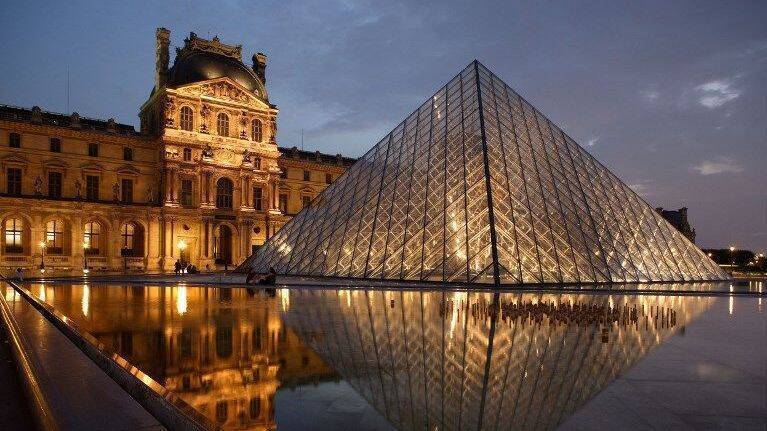
The Napoleonic period substantially reshaped the museum, renamed the “Musée Napoléon” in 1803 and reorganised after 1815, when some looted works were returned. In the nineteenth century, completion of the “Nouveau Louvre” under Napoleon III, linking the Tuileries Palace to the Louvre, expanded the complex, although the 1871 fire at the Tuileries permanently changed the architectural ensemble. Twentieth-century restoration and expansion culminated in the “Grand Louvre”, launched in 1981 and opened in stages. It relocated the Ministry of Finance, reopened the Richelieu wing in 1993 and provided a new emblematic entrance beneath Ieoh Ming Pei’s Pyramid, inaugurated in 1989.
Today a public institution overseen by the Ministry of Culture, the Louvre asserts a strong heritage, scientific and educational mission under its president-director Laurence des Cars, appointed in 2021. With approximately 72,735 square metres of exhibition space and nearly 35,000 works on display, it remains central to French cultural diplomacy and to research in art history and conservation.
Encyclopaedic collections
The Louvre is distinguished by its chronological and geographical scope, from antiquity to 1848, organised into eight departments: Egyptian Antiquities; Greek, Etruscan and Roman Antiquities; Near Eastern Antiquities; Islamic Art; Paintings; Sculptures; Decorative Arts; and Prints and Drawings, the last primarily accessible by appointment or through temporary exhibitions. This structure, established over the twentieth century and complemented by the creation of the Islamic Art department in 2003, reflects a scholarly approach to conserving, studying and sharing works.
Among its most famous pieces, Leonardo da Vinci’s Mona Lisa remains a major attraction, displayed in the Salle des États following changes to the visitor route and presentation in 2019. The Venus de Milo, the Winged Victory of Samothrace at the top of the Daru staircase, the Code of Hammurabi, Canova’s Psyche Revived by Cupid’s Kiss and the Galerie d’Apollon, restored in the twenty-first century, are among the landmarks in a museum narrative combining masterpieces with thematic exploration. Supported by acquisitions, deposits and patronage, this diversity makes the Louvre an encyclopaedic museum in both the classical and contemporary senses.
The museum has invested heavily in digital resources, opening its online “Collections” database with more than 500,000 entries. Researchers, students and curious visitors can consult essential information on works, their provenance and related bibliography. This open-access initiative, strengthened since 2021, supports scholarly transparency and the dissemination of knowledge while complementing the on-site experience with reliable resources.
Iconic masterpieces
The Salle des États, home to the Mona Lisa, was reorganised in 2019 with new visitor circulation and blue walls, alongside a high-performance glazed case meeting conservation and security standards. The Winged Victory of Samothrace, restored and reinstalled in 2014, illustrates the attention paid to the presentation of major sculptures along monumental routes. The Galerie d’Apollon, home to the Crown Diamonds, bears witness to the palace’s decorative function and has been restored through historical studies and contemporary interventions.
In the antiquities collections, the room housing the Code of Hammurabi offers a striking view of Mesopotamian legal systems. The Egyptian Antiquities department, partly derived from collections assembled in Champollion’s era, presents several millennia, from the predynastic period to Ptolemaic and Roman times. In painting, the French, Italian, Spanish, Flemish and Dutch schools form a reference collection in which Poussin, Delacroix, Vermeer, Goya and Titian are brought into dialogue.
Departments and displays
Changing displays respond to research, preventive conservation and visitor needs. Scholarly teams within the departments plan rotations, restorations and renewed routes in conjunction with heritage projects and international loans. The Islamic Art department, opened to the public in 2012 in the Cour Visconti, brought together works from the seventh to nineteenth centuries across a vast territory from Spain to India, within a distinctive architectural setting that preserves the visibility of the historic façades.
Signature architecture: from medieval palace to Pyramid
Today the Louvre reveals the layers of a continuously changing site, from the medieval moat and keep to the classical façades of the Cour Carrée and I. M. Pei’s contemporary intervention. Inaugurated in 1989, the glass-and-steel Pyramid serves both engineering and circulation, lighting a vast underground entrance hall and distributing visitors among the three main wings, Denon, Sully and Richelieu. Made from hundreds of glass panes, the exact number of which has long inspired urban myths, the Pyramid was designed to improve accessibility and accommodate growing traffic.
The Richelieu wing, formerly occupied by the Ministry of Finance, reopened in 1993, completing a major stage of the “Grand Louvre”. It houses parts of the decorative arts and sculpture collections and the Napoleon III apartments, recreating a Second Empire setting that illuminates the history of taste, techniques and use. The Inverted Pyramid in the Carrousel du Louvre, inaugurated in the early 1990s, serves as a secondary entrance from the adjoining shopping centre and helps distribute visitors while becoming an architectural landmark in its own right.
The Cour Visconti and Islamic Art department
Opened in 2012, the Islamic Art spaces occupy the Cour Visconti under a contemporary undulating roof designed by Mario Bellini and Rudy Ricciotti. This glass-and-metal canopy provides transparency that respects the historic elevations while creating conservation and lighting conditions suited to sensitive materials. Arranged over two levels, the displays follow a chronological and geographical route through ceramics, metalwork, glass, textiles, illuminated manuscripts and architectural elements, combining scholarly and educational approaches.
The Pavillon de l’Horloge: understanding the Louvre
Opened to the public in 2016 at the heart of the Cour Carrée, the Pavillon de l’Horloge is an interpretation centre presenting the history of the palace and museum, from excavations to major modern projects. Spread across several levels, it combines models, plans, archival views and multimedia to explain the site’s layers and the formation of the collections. Integrated into the permanent visitor route, it helps visitors understand the buildings and the institution’s missions.
Education and digital tools
The Louvre’s varied educational policy combines on-site facilities, cultural programming and digital resources. The Louvre Auditorium hosts lectures, debates, concerts and screenings that extend the exhibitions and research conducted by its departments. The Petite Galerie, inaugurated in 2015, offers accessible, educational exhibitions designed for young audiences and families, combining Louvre works and external loans in displays created to encourage learning.
Digitally, the museum has developed the official “Louvre” application with thematic routes and practical information, as well as a freely searchable “Collections” database now containing more than half a million entries. During the major 2019 Leonardo da Vinci retrospective, the virtual-reality experience “Mona Lisa: Beyond the Glass”, developed with Vive Arts, offered a documentary exploration of the material history and reception of the work, extending the visit through immersive interpretation. The museum also offers editorial content, videos, podcasts and educational dossiers on its website, developed with scholarly teams to ensure reliable information.
Internal signage, redesigned in stages, improves orientation in a complex building, while suggested routes help visitors discover the highlights in limited time. Available in several languages and with accessibility features, these tools address the needs of diverse audiences, from beginners to researchers. Their aim is to make navigation easier, improve visitor flow and offer multiple entry points into collections of exceptional breadth.
Attendance, access and the visitor experience
According to its reports, the Louvre remains the world’s most visited museum, with 8.9 million visitors in 2023 after a historical record above 10 million in 2018. Management announced an intention to cap daily visitors at around 30,000 to improve the experience, a strategic issue accompanied by closer management of queues and time slots. This policy includes an explicit recommendation to reserve a timed entry slot to spread attendance and limit waiting, while maintaining free-entry arrangements and exemptions defined by applicable rules and detailed on the official website.
The main entrance beneath the Pyramid gives access to three wings and several thematic routes, including those leading to the Salle des États, Daru staircase and Egyptian Antiquities. To meet logistical challenges, the museum regularly adjusts its access instructions, opening times and suggested routes, especially in peak seasons. Online and in-app visitor advice aids preparation, while service updates on temporary closures, works and rehanging keep the public informed.
Restoration and loan policies extend the experience beyond the walls through partnerships with French and international institutions, collection projects and external exhibitions. On site, preventive conservation, climate management and improved visitor flow form part of an overall system that must reconcile heritage preservation with welcoming millions of visitors. Transparency about projects, publication of resources and research outreach through conferences and study days demonstrate a clear scholarly commitment.
Finally, interpretation spaces from the Petite Galerie to the Pavillon de l’Horloge, multilingual audio guides and freely accessible digital content form part of a strategy for wider access and a better visitor experience. Amid digital and ecological transition, considered management of attendance, continuous improvements to the clarity of visitor routes and reliable content appear central to the future of a museum whose history follows that of France and changing perspectives on art.
Sources
Musée du Louvre, history of the palace and museum, including the “Grand Louvre” and I. M. Pei’s Pyramid. https://www.louvre.fr/decouvrir/le-louvre/histoire-du-louvre
Musée du Louvre, key figures and practical information on exhibition space, departments, attendance, access and booking. https://www.louvre.fr/visiter
Musée du Louvre, online collections database with more than 500,000 entries. https://collections.louvre.fr
Musée du Louvre, Islamic Art department, the Cour Visconti and Bellini and Ricciotti’s canopy, opened in 2012. https://www.louvre.fr/decouvrir/les-collections/departements/arts-de-lislam
Musée du Louvre, Pavillon de l’Horloge, interpretation centre opened in 2016. https://www.louvre.fr/ressources/pavillon-de-lhorloge
Musée du Louvre, Salle des États and Mona Lisa information. https://www.louvre.fr/oeuvre-notices/la-joconde
Musée du Louvre press release, 2023 attendance: 8.9 million visitors, trends and visitor experience objectives. https://presse.louvre.fr
The Art Newspaper, “The Louvre to cap daily visitor numbers at 30,000 to improve experience” (2023). https://www.theartnewspaper.com/2023/01/09/louvre-paris-cap-daily-visitors
Musée du Louvre, auditorium and cultural programme, including lectures and concerts. https://www.louvre.fr/agenda/auditorium
Vive Arts / Musée du Louvre, Mona Lisa: Beyond the Glass (2019), virtual-reality experience for the Leonardo da Vinci exhibition. https://www.vivearts.com/collaborations/mona-lisa-beyond-the-glass